Lab Reports 15.0 release notes
Last updated: September 7, 2026
Lab Reports v15 is out!
We are excited to announce the release of Lab Reports v15.0, packed with an exciting feature that everyone’s waiting for - newly revamped cholesterol flow, prescribing for low vitamin D and filing of slight abnormalities of FBCs.
Newly revamped cholesterol flow
We have improved our cholesterol flow to categorised some of the pathways. Please see the summary of changes below:
You now have option to disable text messages for cholesterol levels that are normal or meeting targets (within primary prevention targets).
For patients that are not meeting targets and a task is sent, this is now optional if you want us to check for existing appointment. We will only send a task if the patient does not have an upcoming appointment with clinicians of you choosing. Text messages for cholesterols ‘not to targets’ are also optional.
The flow for Severe Hyperlipidaemia has changed. We will now check against the following values.
Total >7.5
LDL >5.9
Triglycerides >10
Patients on Statins, Diabetics (patients with familial hyperlipidaemia or patients over 85y old)
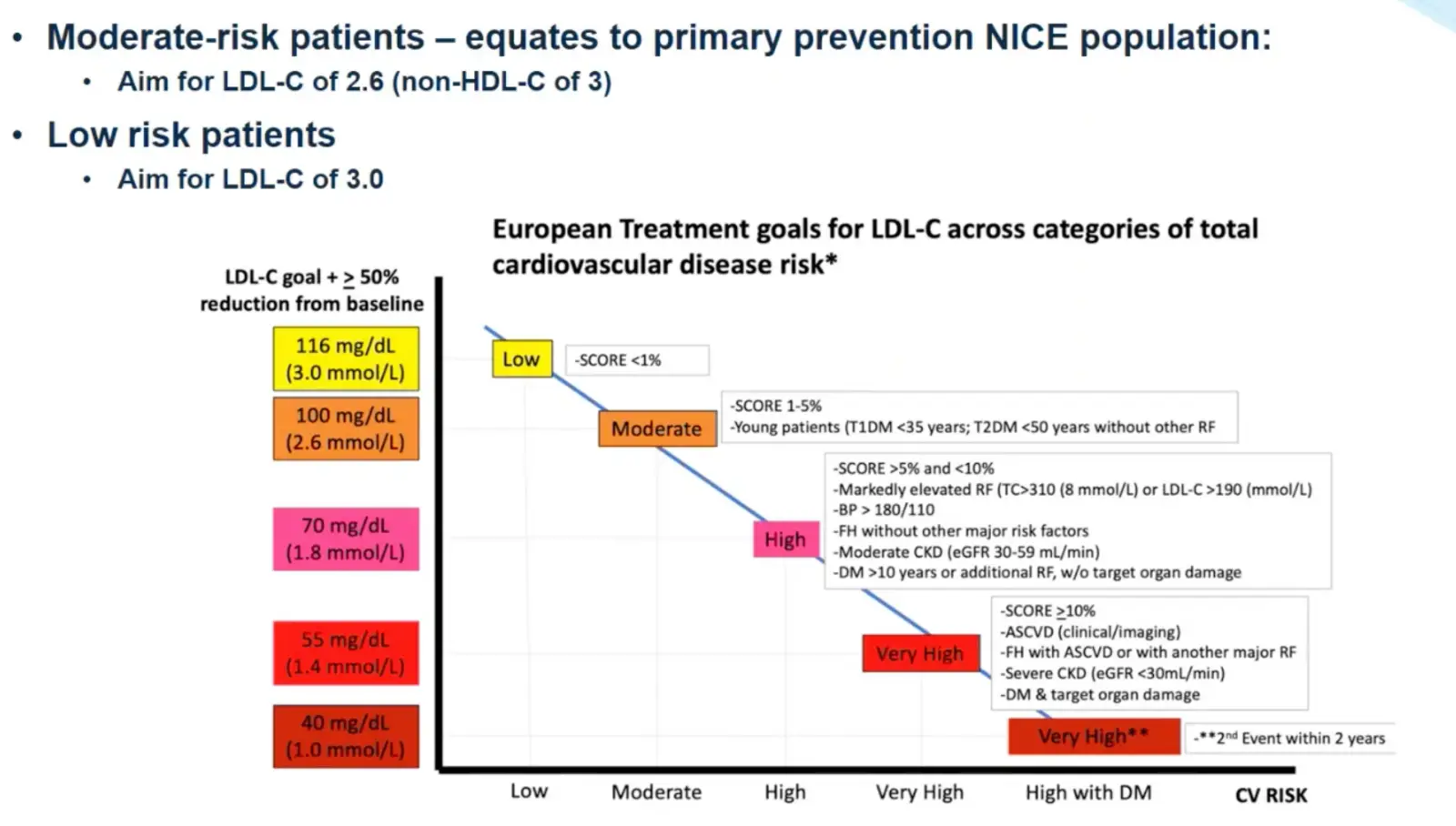
All these patients will be checked against the ESC guidance for “Moderate risk”. We will be checking them against a LDL of <2.6 or a Non-HDL <3.0 or Triglycerides of <4.5.
If they are not meeting this target, we will not send a task, but rather add a sticky note.
Vitamin D Deficiency and Auto-prescription
ℹ Low vitamin D prescribing is coming soon!
The current reference ranges used for Vitamin D are:
Normal (50 - 125)
Insufficiency (25 - 50)*
Low (less than 25)**
configurable based on local guidance
*new flow
We will now be offering the ability to prescribe your standard prescription for Vitamin D Deficiency. This standard Vitamin D will be prescribed unless there is a below contraindication;
Pregnancy
Hyperparathyroidism
Malignant neoplastic disease
Nephrocalcinosis
Breast feeding in the last 2 years
Cirrhosis
If there are no contraindications, we can prescribe your preferred standard vitamin D and place it in the "Prescription with Queries" EPS workflow. A corresponding task will also be assigned to your chosen team and a sticky note is added.
Please note we can only prescribe one medication at present and please be aware of Vegetarians/Halal and Kosher (or other) preparations.
Full Blood Count - Slight Abnormalities
We have developed this flow with Haematologists from Imperial College London.
The haemoglobin, white blood cell count and platelets must be normal.
If there are minor abnormalities, which have been deemed non-significant (but are classed as “Abnormal” by EMIS), we are able to automate them.
This will significantly improve the number of reports automated in your pathology inbox across the board.
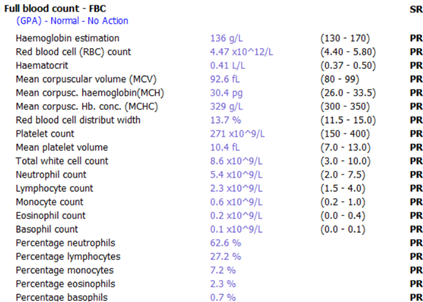
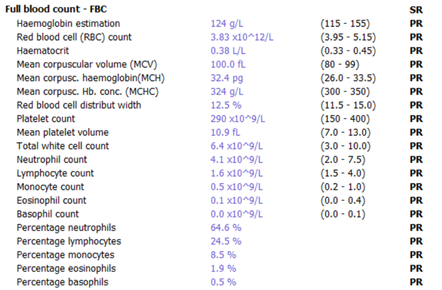
Below are two example Full blood count reports for Male and Female patients, highlighting the features and normal EMIS reference ranges.
Example: Full blood count – FBC (Male)
Example: Full blood count – FBC (Female)
Normal range features:
The below features will only be filed if normal according to EMIS, i.e. being within the specified reference range of your Full blood count -FBC report, this will be true for Male and Female reports.
Haemoglobin
White Cell Count
Platelets
Neutrophils
Lymphocytes
Monocytes
Eosinophils
Mean Corpuscular Volume (MCV)
Platelet distribution width*
Nucleated red blood cell count*
Please note that, depending on your laboratory provider, other features may be included in your FBC report, such as Platelet distribution width and Nucleated red blood cell count. These will adhere to the outlined ranges and will only be filed if normal. The above list is not exhaustive, and any other features that may be included in your reports will only be filed if normal.
Extended range features:
The features below are the features where GP Automate will file your Full blood count – FBC report with minor abnormalities. The reference ranges for the following features, under careful consideration with a Haematologist from Imperial College London, have been extended to allow for reports within these extended ranges to be filed. Reports where values fall outside the EMIS range for the features below will only be filed if all the normal range features are normal (as highlighted in the previous section). This ensures significant features such as haemoglobin, white blood cell count, and platelets remain in the EMIS assigned reference range.
Feature | Example EMIS Range (Male)** | Extended GP Automate | Example | Extended GP Automate Range (Female) |
Basophils | [0-0.1] | [0-0.5] | [0-0.1] | [0-0.5] |
Red Blood Cell Count (RBC) | [4.4-5.8] | [3.5-6.5] | [3.95-5.15] | [3-6] |
Haematocrit | [0.37-0.5] | [0.33-0.52] | [0.33-0.45] | [0.3-0.48] |
Mean Corpuscularhaemoglobin (MCH) | [26-33.5] | [20-40] | [26-33.5] | [20-40] |
Mean Corpusc Hb conc (MCHC) | [300-350] | [250-400] | [300-350] | [250-400] |
Red Blood Cell Distribution Width | [11.5-15] | [9-18] | [11.5-15] | [9-18] |
Mean platelet volume | [7-13] | [5-15] | [7-13] | [5-15] |
Please note that dependent on your laboratory provider, the reference ranges found in your reports may vary from the examples shown.
Other considerations:
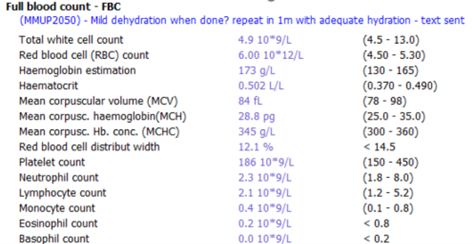
If your Full blood count – FBC comes with less than ranges (<), the lower value will be considered to be zero (0).
For example: Eosinophil count will be considered greater than 0 to less than 0.8 [0-0.8]. With this range being considered normal.
Example: Full blood count – FBC (< ranges)
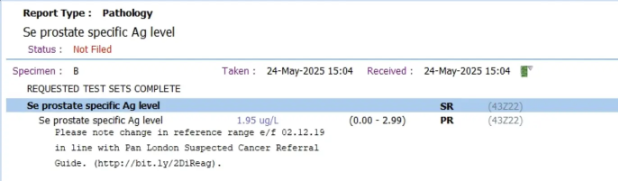
Prostate Specific Antigen Test
We are now able to file Prostate Specific Antigen test results according to the NICE guideline reference ranges:
< 40 years: Use clinical judgement
40–49 years: Between 0 and 2.5 ng/mL
50–59 years: Between 0 and 3.5 ng/mL
60–69 years: Between 0 and 4.5 ng/mL
70–79 years: Between 0 and 6.5 ng/mL
79 years: : Use clinical judgement (more complex)
For patients <40y and >79y old with a PSA in the inbox, the report will be skipped.
Exclusion Criteria
On processing PSA results, if any patient has a code of Prostate Cancer (Malignant Neoplasm of Prostate) will be skipped
Any Patients who are taking either Finasteride or Dutasteride (within the last 6 months) will also be excluded.
If any patients are in the exclusion criteria, the report will be skipped and left in the inbox for a clinician to deal with.
Here is the link to the NICE guidance:
https://cks.nice.org.uk/topics/prostate-cancer/diagnosis/assessment/
Improvements to Enhanced Automations
Currently we were only able to process renal/eGFR reports in the normal filter due to complexity in checking for eGFR drop.
With our latest v15, we are now able to process eGFR reports that are in abnormal range as well as checking for eGFR drop and CKD codes.
Other updates in the release
Ability to process reports with a adjusting lower age limit:
We made a clinical decision to only process reports of patients over the age of 18 up to 110 by default. However, this can be changed by sending us a support ticket.
You can reduce the lower age of 18 to e.g. 16 and we will clinically review this and inform you after making this change.
Bug fixes:
Issue with sending a self booking link has now been resolved. Bot will continue to send self booking links via Accurx.
There was a minor issue where bot was not sending text messages for a couple of lipid pathways. This has now also been resolved.